This train route has it all.
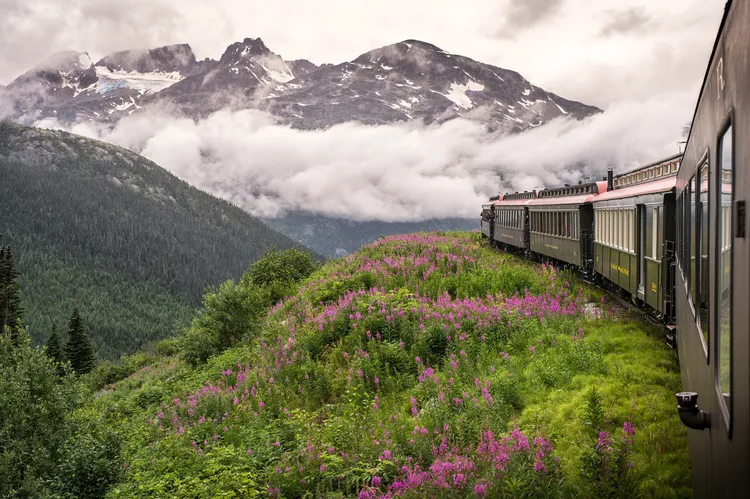
Few railroads pack as much history into so few miles as the White Pass & Yukon Route Railway. Built at the height of the Klondike Gold Rush, the 110-mile narrow-gauge railroad links Skagway, Alaska, with Whitehorse, the capital of Canada’s Yukon Territory, climbing from sea level to the 2,885-foot White Pass summit before continuing into British Columbia. Although only portions of the original line operate for passengers today, the railroad remains one of North America’s great scenic train rides.
Its story begins with the Klondike Gold Rush. After gold was discovered in the Yukon in 1896, roughly 100,000 people set out for the goldfields around Dawson City, Canada. Most of these “stampeders,” as they became known, reached the region by steamship to Skagway or nearby Dyea, Alaska, before attempting to cross the Coast Mountains via the White Pass or Chilkoot trails. The journey was notoriously brutal. Canadian officials required each prospector to carry about a year’s worth of supplies (weighing roughly one ton) to prevent starvation, forcing stampeders to make dozens of trips over steep mountain passes before they could continue by boat down the Yukon River.
Recognizing the need for a better route, investors began building the White Pass & Yukon Route Railway in May 1898. Workers blasted through solid granite, carved ledges into near-vertical mountainsides, and erected steel bridges and timber trestles across deep gorges—all while battling avalanches, harsh winters, and remote conditions. The first train reached the White Pass summit in February 1899, and by July 1900, the railroad had extended all the way to Whitehorse. What had taken stampeders days of grueling climbing could now be completed in a matter of hours.
Freight service on the line largely ended in 1982 after the closure of the Faro lead-zinc mine in the Yukon, but the railroad was revived in 1988 as a heritage attraction. Today, the railroad’s greatest draw is the scenery, carrying hundreds of thousands of passengers each year on excursions ranging from the popular White Pass Summit trip to longer journeys into British Columbia and the Yukon, past waterfalls, soaring cantilever bridges, and traces of the Klondike Gold Rush that are inaccessible by road. However, Jaime Bricker, the tourism director for Explore Skagway and a former White Pass employee of 14 years, says first-time riders shouldn’t liken it to an amusement park ride.
“To construct this railroad, engineers and workers overcame design challenges, granite mountains, steep grades, cliff-hanging turns, and unimaginable weather conditions. And they did it all without our modern tools of today,” says Bricker, who notes White Pass is an International Historic Civil Engineering Landmark.
Here’s what you need to know before riding the White Pass & Yukon Route Railway.